• Essence

    Despite its fame as a resplendent island and a leading tourist destination, the secret of Sri Lanka’s attraction lies with its people. The spice addicted, cricket crazy and tea drinking people of Sri Lanka are famed for big smiles and ....

  • Festive

    Sri Lanka having a history as long as many ancient civilizations, positioning in the crossroad of the East and the West, and being a multicultural society, celebrates a wide variety of festivals, ceremonies and events.

  • Heritage

    Heritage With a history expanding over 3000years, Sri Lanka holds some of world’s ancient cities including Anuradhapura, Polonnaruwa and Digamadulla; their once glorious townships, palaces, temples, monasteries, hospitals and ...

  • Bliss

    Sri Lanka had continued to inspire and heal many who travelled to its shores ever since its existence was known to the world.

  • Pristine

    With nearly 1600 km of of palm fringed Coastline baked to perfection surrounding the country Sri Lanka is the ideal destination for beach bums worldwide.

  • Scenic

    Sri Lanka is filled with romantic landscapes, governed by rising mountains, lush forests, ocean like tanks and gushing waterfalls, that it was considered the lost paradise by many a globe trotters, who fell upon the country.

  • Thrills

    With varying climates and Geography packed into a small island Sri Lanka offers a range of adventures from the top of the mountains to the depths of the oceans.

  • Wild

    Despite its small size Sri Lanka boasts of one of the highest rates of biological endemism in the world whether in plants or animals and is included among the top five biodiversity hotspots in the world.

Wednesday, May 8, 2013

0

Vesak in Sri Lanka


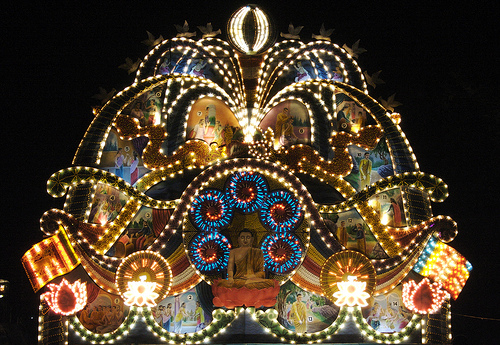
Vesak is considered as both a religious and cultural festival in Sri Lanka. It is celebrated on the day of the full moon in May. Vesak Day is one of the biggest days of the year in the Buddhist calendar and is celebrated by Buddhists all over the world. Buddhists commemorate the important events that took place in the life of Lord Buddha on this Vesak Full Moon Poya Day. First comes the birth of Siddhartha Gautama in Lumbini in Nepal which took place under the arbor of Sat trees where queen Mahamaya gave birth to him. The second event was Siddharta Gautam's supreme attainment as the Buddha, the Enlightened One. The third event was Lord Buddha's Parinibbana over 2500 years ago at Kusinagar.

Apart from Sri Lanka, many Asian countries including India, Japan, Singapore, Taiwan, Indonesia and Nepal celebrate Vesak. Many religious activities are organized during this period in Sri Lanka such as Sil campaigns, Bodhi Poojas, Dansalas (Freely giving foods, coffee, tea from people), Vesak devotional songs (Bakthi Gee), pandols (thoran) and lanterns.


Sunday, May 5, 2013

0

Peradeniya Botanical Garden

Royal Botanical Garden, Peradeniya is situated about 5.5 km to the west from the city of Kandy in the Central Province of Sri Lanka and attracts 2 million visitors annually.[1] It is renowned for its collection of a variety of orchids. It includes more than 4000 species of plants, including of orchids, spices, medicinal plants and palm trees.[2] Attached to it is the National Herbarium. The total area of the botanical garden is 147 acres (0.59 km2), at 460 meters above sea level, and with a 200-day annual rainfall. It is managed by the Division of National Botanic Gardens of the Department of Agriculture.
The origins of the Botanic Gardens date as far back as 1371 when King Wickramabahu III ascended the throne and kept court at Peradeniya near Mahaweli river. This was followed by King Kirti Sri and King Rajadhi Rajasinghe. A temple was built on this location by King Wimala Dharma, but it was destroyed by the British when they were given control over the Kingdom of Kandy. Thereafter, the groundwork for a botanical garden was formed by Alexandar Moon in 1821. The Botanical Garden at Peradeniya was formally established in 1843 with plants brought from Kew Garden, Slave Island, Colombo, and the Kalutara Garden in Kalutara. The Royal Botanic Garden, Peradeniya was made more independent and expanded under George Gardner as superintendent in 1844.On his death in 1849 George Henry Kendrick Thwaites became superintendent. He served until 1879, when he was succeeded by Henry Trimen,[3] who served until 1895.[4] The Garden came under the administration of the Department of Agriculture when it was established in 1912.


0

Arankele Monastery in Sri Lanka

Huge trees, creepers and stone pillars scattered around Arankele speak of an intriguing civilisation, a bygone era, while rare species of insects, found in abundance, tell of a rich, biological heritage. However, Arankele is not an old kingdom or a palace which once sheltered a mighty king. The whole forest was designed for another purpose.It was built to shelter the Buddhist monks who spent their time in meditation to reach the ultimate state a human can ever reach.

The vast forest land was scattered with patanagara or apartments designed for meditation, bathing ponds providing hot and cold water, a hall designed for walking and a two kilometre walking path designed for the monks to meditate while walking.The special characteristic of the patanagara is that each was surrounded by a water canal perhaps to keep the interior of the apartments cool. Some apartments stand alone while some are twin apartments. The twin apartments are connected together via a stone bridge.

0

World's End (Horten Place)

Horton Plains National Park is a protected area in the central highlands of Sri Lanka and is covered by montane grassland and cloud forest. This plateau at an altitude of 2,100–2,300 metres (6,900–7,500 ft) is rich in biodiversity and many species found here are endemic to the region. This region was designated a national park in 1988. It is also a popular tourist destination and is situated 32 kilometres (20 mi) from Nuwara Eliya and 8 kilometres (5.0 mi) from Ohiya
The Horton Plains are the headwaters of three major Sri Lankan rivers, the Mahaweli, Kelani, and Walawe. In Sinhala the plains are known as Maha Eliya Plains. Stone tools dating back to Balangoda culture have been found here. The plains' vegetation is grasslands interspersed with montane forest, and includes many endemic woody plants. Large herds of Sri Lankan Sambar Deer feature as typical mammals, and the park is also an Important Bird Area with many species not only endemic to Sri Lanka but restricted to the Horton Plains. Forest dieback is one of the major threats to the park and some studies suggest that it is caused by a natural phenomenon. The sheer precipice of World's End and Baker's Falls are among the tourist attractions of the park


0

Gems ln Sri Lanka

Rathnapura, the city of Gems 

Rathnapura as its name implies had been centre of a long-established industry of precious stone mining and had been hailed for its precious rubies and sapphire even back in the first century AC. 
Being the central city of the Sabaragamuwa province Rathnapura is a major crossroad between southern plains and the hill country to the east. With lush plantations of tea and rubber and water falls governing the sights the district is also a popular tourist destination. 
Sinharaja Forest Reserve, a biodiversity hot spot, a biosphere reserve and a UNESCO world heritage site borders the Rathnapura district while Udawalawa National Wildlife Park is the most accessible elephant habitat from capital, Colombo. 
Rathnapura’s numerous waterfalls provide ideal picnic spots and recreation to many who flock to the city during the vacations while sacred Samanala Kanda or the Adam’s Peak is believed to hold the footmark of Lord Buddha himself. 
In the midst of Rathnapura is the Maha Saman Devalaya, the main temple of God Saman, the patron deity of Sri Lanka itself.

0

Furniture in Sri Lanka

Singhe Furnitures, a well known name in Sri Lankan furniture industry comes with a 35 year proud history. It is renowned for its unmatched quality and service assuring you value for money with every purchase you make. We pride ourselves on our ability to provide a service that is tailored, experienced and thorough: quality & attention to detail define who we are. We strive to set new standards in delivering impeccable quality and uncompromising attention to detail in both service and design. Our reputation for pushing boundaries in design and application ensures we continue to exceed all expectations.

We specialize in exclusive teak furniture and give a life time warranty for our high quality teak wood. Since we only undertake teak furniture we have become an exclusive supplier for all your furniture needs at affordable prices unmatched by any other in the industry.
Our main product offerings are Exclusive Designer Teak Sofas, Teak bedroom furniture and
Teak living room furniture.


Friday, May 3, 2013

0

Handicrafts In Sri Lanka

Sri Lanka handicrafts are of a history that runs back to millenniums. Production of Sri Lanka’s handicrafts, with the exception of Jewelry, is essentially a cottage industry: products are turned out making use of natural raw materials by means of time tested age-old techniques. The traditional skills have been preserved with its purity, resulting in the continuance of characteristic identity of Sri Lanka Handicrafts.

Sri Lanka’s ancient social system having its Indo-Aryan roots has been largely instrumental in preserving traditional skills with its characteristic identity; certain arts and crafts were assigned to defined socio-occupational groups. Sri Lanka’s wide variety of very attractive handicrafts can be found throughout the island in shops, street stalls and government-run stores. Ivory and tortoise shell handicrafts once sold at large, are no longer legal in SriLanka.


0

Brass Work In Sri Lanka

Kandy is famous for quality artistic brasswork in Sri Lanka. Experts in traditional brasswork live in Daulagala, Handessa, Pamunuwa, and Pilimatalawa areas in Kandy. They use wrought and cast techniques to produce different types of brass items. Bowls, tea sets, decorative items and ornaments are made especially by the wrought technique.Brass is an alloy of copper and zinc. Brass castings are done using clay moulds. First the model of the item to be casted is made using wax. Later, this wax model is covered with clay and the whole thing is baked so that the wax model inside the clay cover melts out leaving the clay cover as the mould. Then molten brass is poured into the clay mould to produce the item. This item is decorated and polished before sending to showrooms.

Items like ceremonial oil-lamps, decorated bowls, candle-stands, elephants, and Buddha statues are made using the casting technique.
Metal cutwork is another technique widely used in Kandyan brasswork to produce trays and wall plaques. In cutwork technique the design is cut deeply into a sheet of brass using various chisels and later the formed design is refined by embellishing and polishing. A method of embellishing designs on brass is to hammer the reverse of the design on a brass sheet using a blunt chisel-like tool to make it appear embossed on the other side. This is called the Repousse method. Sometimes, parts of the design on brass sheet will be oxidized to give a darker colour that will enhance the work of art.
The traditional Kandyan craftsmen decorate their brass works of art with elegant local motifs using hand tools. These are truly the icons of rich artistic heritage of Sri Lanka.


                                                                    See More >>
0

Adam's Bridge (Rama's Bridge)

 Adam's Bridge (Tamil: ஆதாம் பாலம் ātām pālam), also known as Rama's Bridge or Rama Setu (Tamil: இராமர் பாலம் Irāmar pālam, Sanskrit: रामसेतु, rāmasetu),[1] is a chain of limestone shoals, between Pamban Island, also known as Rameswaram Island, off the southeastern coast of Tamil Nadu, India, and Mannar Island, off the northwestern coast of Sri Lanka. Geological evidence suggests that this bridge is a former land connection between India and Sri Lanka.[2]

The bridge is 18 miles (30 km) long[3] and separates the Gulf of Mannar (southwest) from the Palk Strait (northeast). Some of the sandbanks are dry and the sea in the area is very shallow, being only 3 ft to 30 ft (1 m to 10 m) deep in places, which hinders navigation.[2][4][5] It was reportedly passable on foot up to the 15th century until storms deepened the channel: temple records seem to say that Rama’s Bridge was completely above sea level until it broke in a cyclone in AD 1480


                                                                         See More >>

Thursday, May 2, 2013

0

Vesak Festival- 25th May

               
Vesak  is a celebration that commemorates the Buddha's birth, enlightenment, and death, and his passing into nirvana. It is named for the month of May and is celebrated on the full moon, when the Buddha's mother is said to have given birth to him in a garden in the Himalayan foothills while en route to her parents' home .Vesak is celebrated as a religious and a cultural festival in Sri Lanka on the full moon of the lunar month of Vesak (Usually fall on Gregory month of May), for a duration about one week. During this week, the selling of alcohol and fresh meat is usually prohibited, with abattoirs also being closed. Celebrations include various religious and alms giving activities. Electrically lit pandols called toranas are erected in various locations mainly in Colombo, Kandy, Galle and elsewhere, most sponsored by donors, religious societies and welfare groups.


                                                                        See More >>


Wednesday, May 1, 2013

0

Sri lanka Highterest village


Shanthipura is the highest village in Nuwara Eliya. If you want go to the shanthipura you should go through the Nuwara Eliya – Kandy Road. There is the Place called Kalapura in Shanthipura. In Kalapura there is a Stage for see the surrounding of the Nuwara Eliya town. You can see Pidurutalagala, Adams peak, Gregory’s Lake, Hakgala Mountain, Nuwara Eliya town from this Stage


                                                         See More >>


0

Sri Lanka Amazing Place


                                           Waulpane Cave

Wavula Pane is a cave located in Bulutota Rakwana range, northwest of Embilipitiya one of the archeological site located in Sri Lanka. The cave is located in the Ratnapura District, in the Kolonne Korale, about 278 m (912 feet) above sea level. The meaning of Wavul Pane (Sinhalese name) is Cave of Bats. Approximately more than 250,000 bats that inhabit it.


                                                                        See More >>